What Is Spaced Repetition? The Science-Backed Study Method Explained
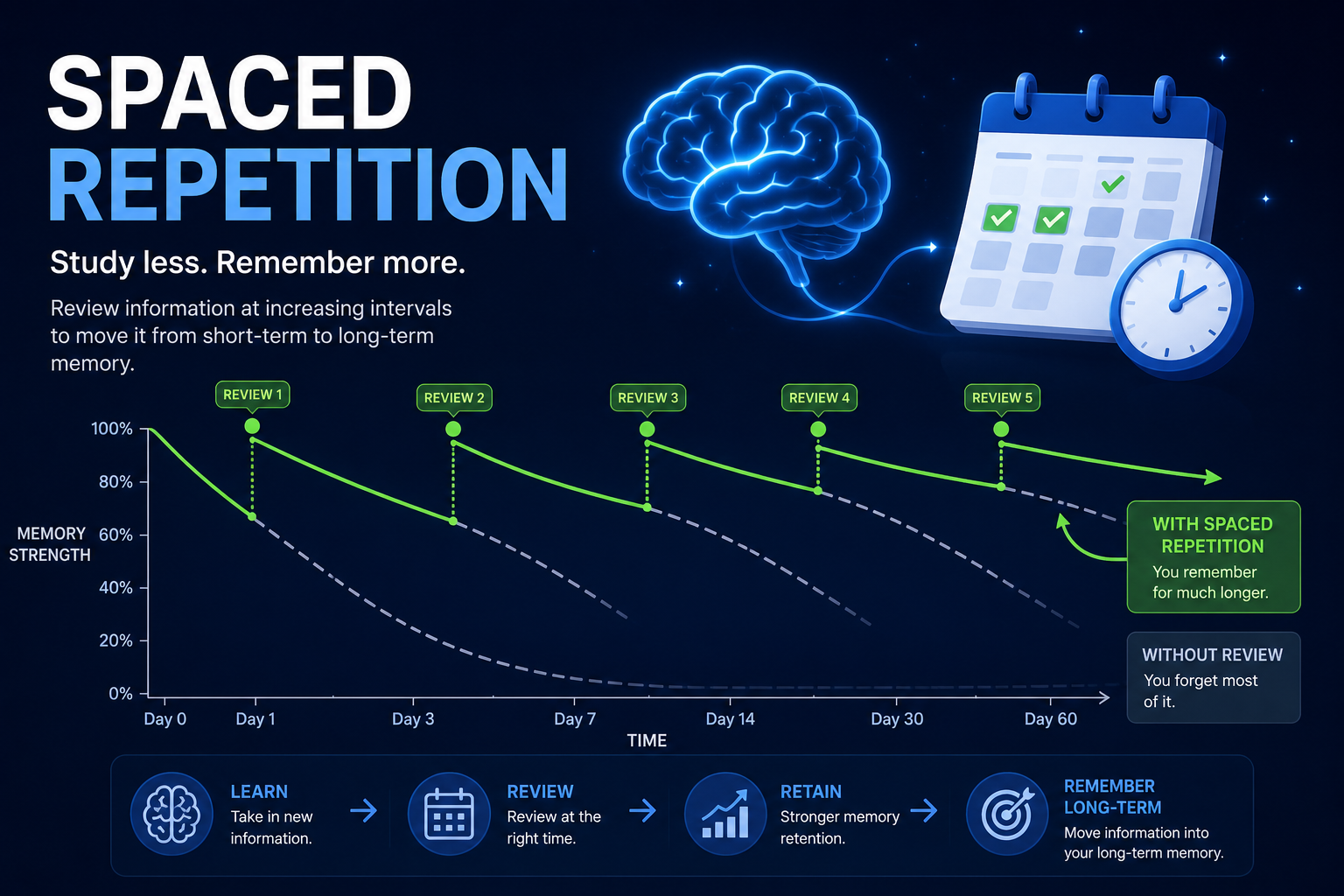
Spaced repetition is a study method that helps you remember information for longer by reviewing it at carefully timed intervals. Instead of reviewing the same material every day, you revisit it after progressively longer gaps, such as one day, several days, and then weeks later. The key is reviewing information just before you're likely to forget it, which strengthens long-term memory while minimizing unnecessary reviews.

You spend hours reading a textbook, highlighting important passages, and taking detailed notes. It feels like you're learning. But a month later, you struggle to remember even the main ideas.
This happens because reading, highlighting, and taking notes alone aren't enough to build lasting memories. Without reviewing information over time, your memory naturally fades, causing you to forget much of what you learned.
Spaced repetition helps prevent this by scheduling reviews before you're likely to forget what you've learned.
In this guide, you'll learn what spaced repetition is, how it works, why it's so effective, where it came from, and how you can use it to remember more of what you learn.
What Is Spaced Repetition?
Spaced repetition is a learning technique designed to help you remember information for the long term by scheduling your reviews at carefully timed intervals. Instead of reviewing the same material every day, you revisit it over progressively longer periods as your memory becomes stronger. This allows you to retain information for months or even years while spending less time on unnecessary reviews.
It's called spaced repetition because each review session is spaced apart over time rather than being crammed into a single study session. Every successful review strengthens the memory, allowing the interval before the next review to gradually increase.
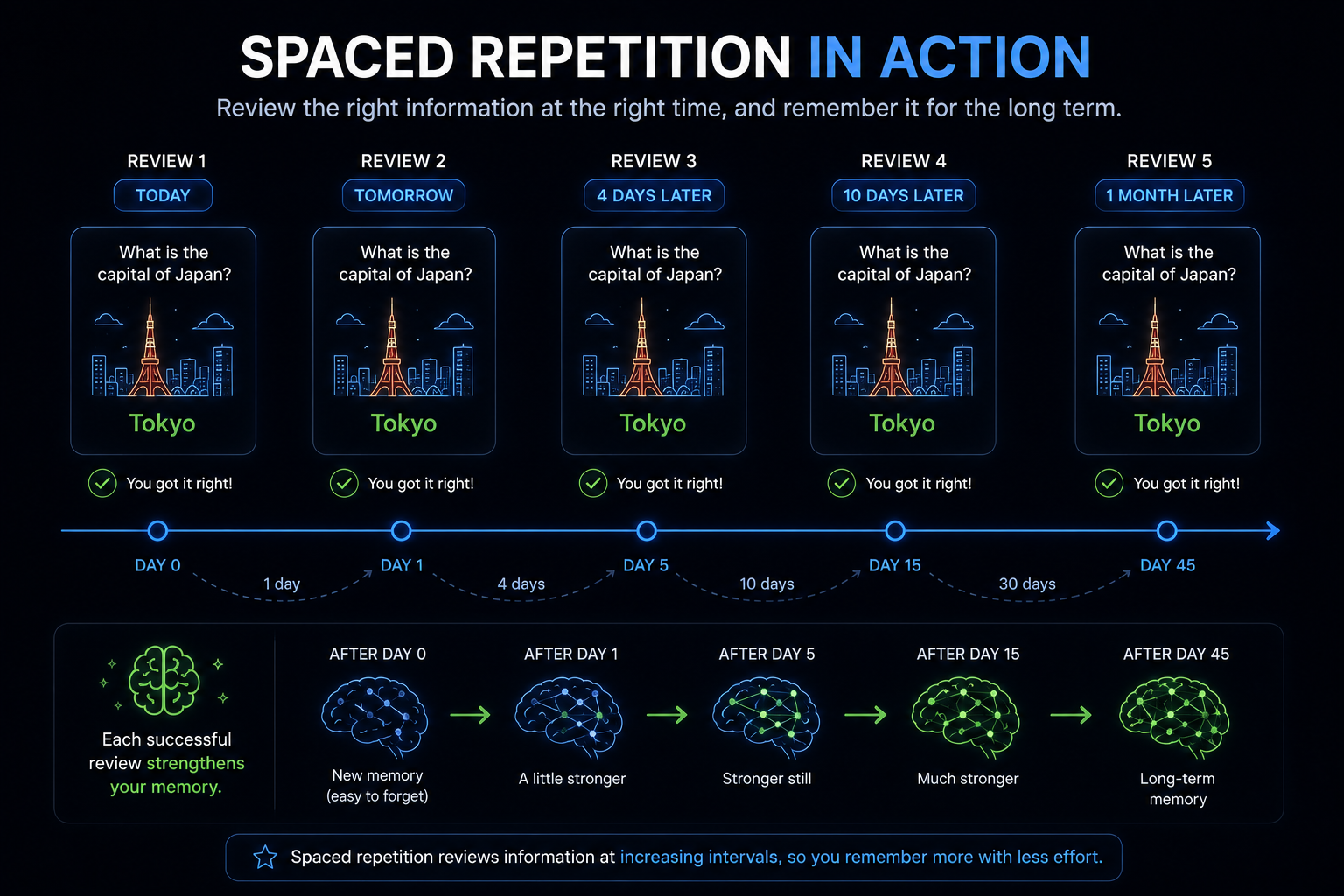
For example, imagine you're learning that the capital of Japan is Tokyo. Instead of reviewing "Tokyo" ten times in one day, you might review it today, then tomorrow, four days later, ten days later, and finally a month later. Each successful review reinforces the memory, making it less likely that you'll forget it in the future.
The goal of spaced repetition is to review information just before you're likely to forget it. By doing so, you strengthen long-term memory while minimizing the number of reviews needed to retain the information.
It's important to understand that spaced repetition doesn't follow the same schedule for everyone. The ideal review intervals depend on factors such as how difficult the material is, how well you remember it, and your previous review history. Modern spaced repetition systems can even personalize these intervals automatically, helping you review each piece of information at the most effective time.
Why Is Spaced Repetition So Effective?
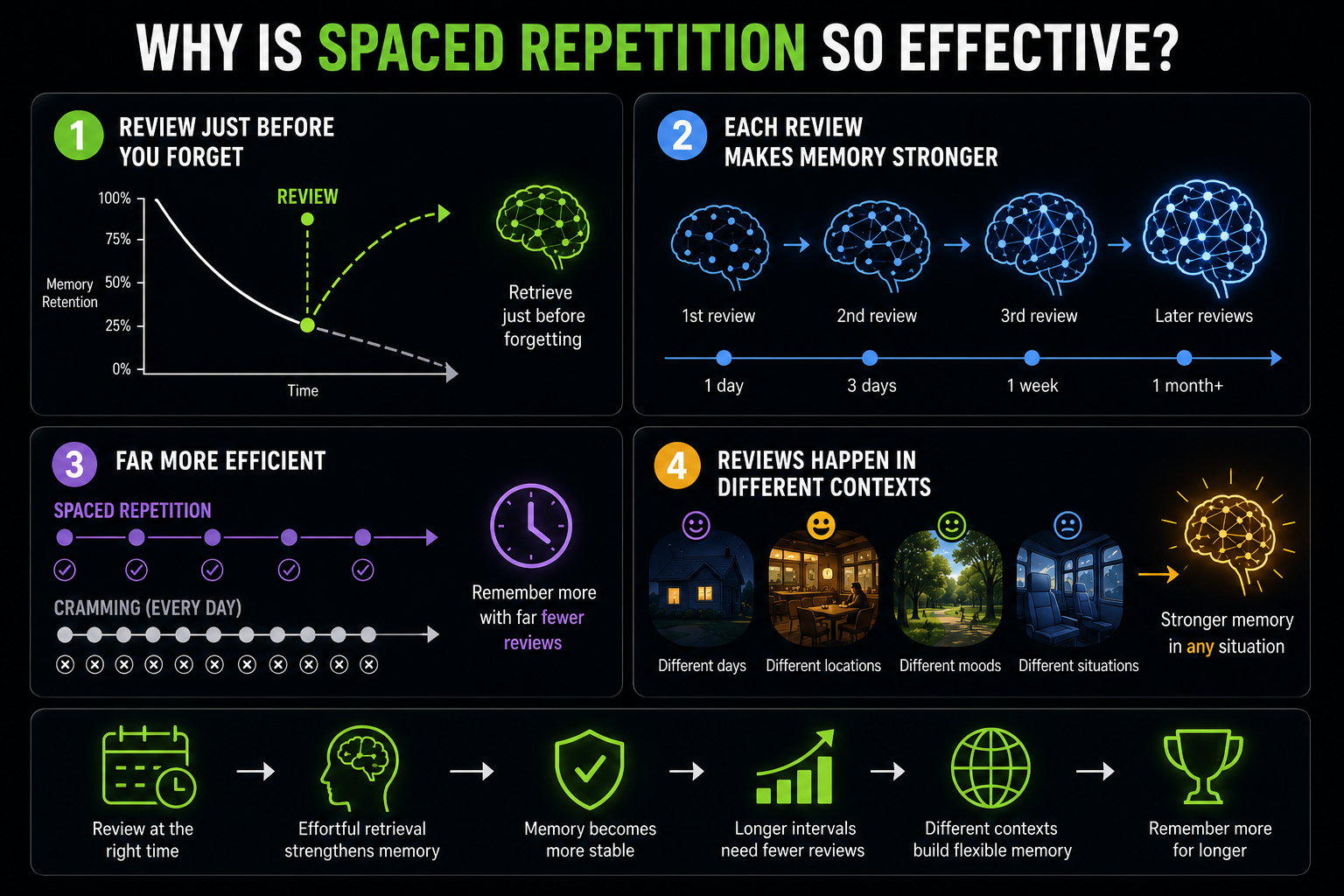
Spaced repetition is effective because it takes advantage of how memory works. Instead of reviewing information repeatedly in a short period, you review it just before you're likely to forget it. This creates a desirable difficulty—retrieving the information requires some effort, and that extra effort strengthens the memory more than if the answer were still fresh and easy to recall.
Each successful retrieval also increases the stability of the memory, meaning it takes longer before you're likely to forget it again. As a result, the time between reviews can gradually become longer—from one day, to several days, to weeks, or even months—while still maintaining high retention.
Because the intervals grow over time, spaced repetition lets you remember information for years with far fewer reviews than if you reviewed everything every day, making it both highly effective and time-efficient.
Another benefit of spaced repetition is that reviews naturally occur in different contexts. Because you retrieve the same information on different days, in different locations, and often in different moods, the memory becomes less dependent on a single context or emotional state. This makes it easier to recall the information in a wide variety of real-world situations, rather than only in the environment where you first learned it.
How to Start Using Spaced Repetition
There are several ways to use spaced repetition, but they all follow the same basic principle: you need a way to know what to review and when to review it.
One simple approach is to schedule review sessions in a calendar. For example, after learning about cellular respiration, you could add reminders to review the topic today, then again in 4 days, 14 days, and 30 days. When each reminder appears, try to recall everything you can remember about the topic before checking your notes. Testing your memory first is much more effective than immediately rereading your notes.
An even better approach is to use flashcards. After studying cellular respiration, you could create a flashcard with:
Front: What is cellular respiration?
Back: The process by which cells convert glucose into ATP (energy), producing carbon dioxide and water.
During each review, try to answer the question from memory before revealing the answer. If you remember it correctly, you can wait longer before reviewing it again. If you struggle, you'll review it sooner.
While paper flashcards work, digital flashcards are usually the most convenient option because they can automatically schedule your reviews based on your performance. Apps like Neuraloop, Anki, and other spaced repetition systems calculate the optimal time to review each flashcard, removing the need to plan review intervals yourself.

Spaced Repetition vs. Massed Practice
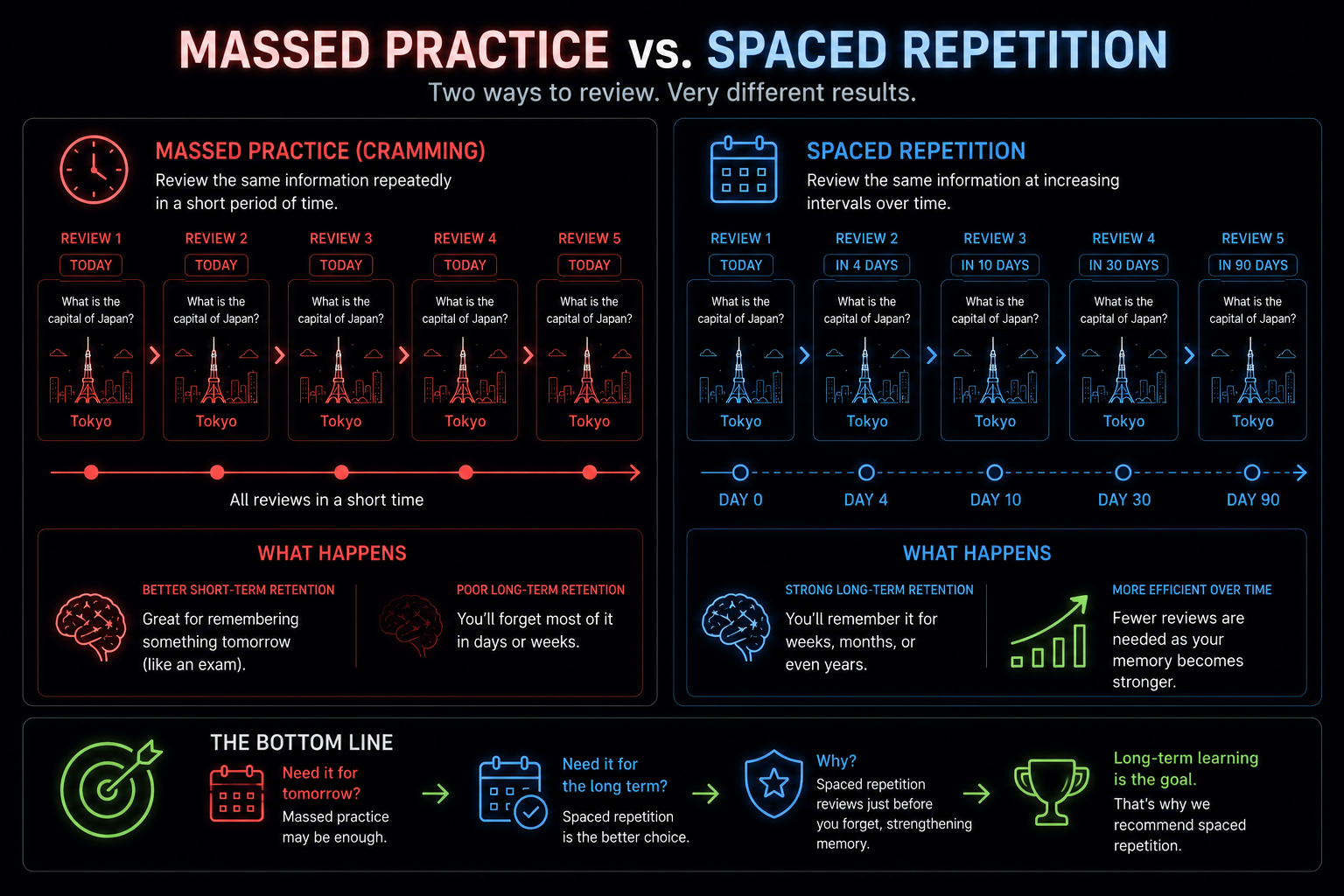
Massed practice, often called cramming, involves reviewing the same information repeatedly over a short period without spacing the reviews over time.
While massed practice can produce better short-term retention, such as remembering material for an exam the next day, it is much less effective for building memories that last weeks, months, or years. This is because repeated reviews become too easy, providing little opportunity for the effortful retrieval that strengthens long-term memory.
Spaced repetition, on the other hand, is designed for long-term retention. By reviewing information just before you're likely to forget it, each successful retrieval strengthens the memory and allows the next review to be scheduled further into the future.
If your goal is simply to remember something for tomorrow, massed practice may be enough. But if you want to remember what you learn long after the exam or course has ended, spaced repetition is the better choice. That's why we recommend using spaced repetition whenever long-term learning is the goal.
History
The scientific foundations of spaced repetition can be traced to German psychologist Hermann Ebbinghaus, who published his memory experiments in 1885. Ebbinghaus found that forgetting followed a predictable pattern: newly learned information was forgotten rapidly at first, while the rate of forgetting gradually slowed over time. This pattern became known as the forgetting curve.
Nearly a century later, Polish researcher Piotr Woźniak began experimenting with review schedules while trying to retain large amounts of information as a student. In 1985, he developed an early paper-based system that increased the interval after each successful review. In December 1987, he created the first computerized version of SuperMemo, short for "Super Memory."
Modern algorithms have made spaced repetition increasingly personalized. FSRS, or Free Spaced Repetition Scheduler, models each item using factors such as its difficulty, memory stability and current retrievability. It can learn from a person's review history and adjust its parameters to better predict when that individual is likely to forget something.
Although the technology has evolved considerably, the central principle remains the same: allow enough time between reviews to make retrieval challenging, without waiting so long that the information becomes excessively difficult to recall.